
Why my grief over Glen Hansard's death has been so overwhelming

Updated: Aug 10
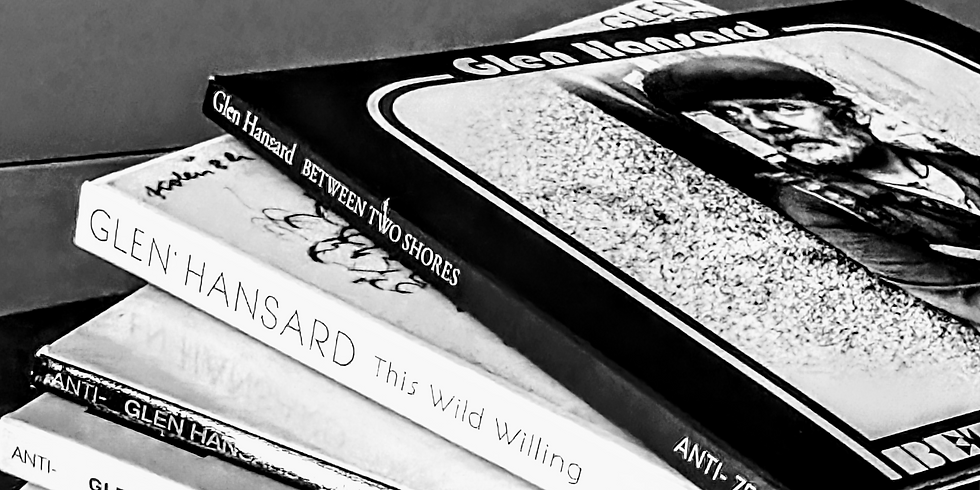
Last week, I was shocked when the death was announced of Irish singer Glen Hansard. He died in a motorbike accident. He was 56, leaving behind a wife and three-year-old son as well as his family, friends and (like me) countless fans of his music.
Celebrity deaths are always sad. When someone whose work you enjoy dies, there's that sadness of a life ending. Over the years I have noticed my sadness – like when Michael Jackson died, when Prince died, when the actress Catherine O’Hara died and more recently when Moya Brennan of Clannad died and also the actor Sam Neil.
What I've experienced with the death of Glen Hansard has been on another level. A genuine sense of personal loss. A grief that I can only attribute to being like when a family member has died. I felt the heaviness of grief envelope me like a dark, heavy shawl. My heart sank and hurt. Why was this happening to me?
As a therapist I understand grief - I work with clients who are grieving and one of the great privileges of working in this field is being alongside clients as they work through loss. And here I am, with this acute grief over the death of someone I had never met.
The profound grief of losing a public figure is evidence of a real psychological connection known as parasocial grief. In psychology, the bond formed with someone in the public eye is called a parasocial relationship. While it is one-sided, your brain doesn't process emotional attachment differently just because you haven't shaken their hand.
Grief counsellor Dr. Kenneth Doka (1989) coined the term disenfranchised grief to describe sorrow that isn't openly acknowledged, socially validated, or publicly mourned in traditional ways. This happens when other people don’t recognise the importance of the relationship, the type of loss is minimised, or the person grieving isn’t seen as a “legitimate” mourner. People often feel awkward grieving a celebrity because well-meaning friends might say, 'Why are you so upset? You didn't even know them.' This response invalidates the loss, forcing people to grieve in secret and making the pain feel even heavier.
On the day that Glen Hansard died, I spent hours scrolling social media. The algorithm picking up on my search to connect with others who were feeling the same sense of shock and sadness as I did. It wasn’t hard to find others in the same place as me and there was a comfort in reading what others were starting to post. Well-known singers and performers and other public figures also shared their profound sense of sadness. But I also felt uneasy in my feelings – they were surely disproportionate to the actual relationship I had with Glen Hansard. He didn’t know me – it was a totally one-way relationship – right?
Why was I so sad?
When a public figure dies, the grief is rarely just about the individual; it’s often about what they represented in your life. They can represent an anchor of nostalgia: They may have been the soundtrack to parts of your life, a comfort during tough times, or signified a bond you shared with special person. Grieving them means grieving a chapter of your own life. This was certainly true with regards to Glen Hansard. His Oscar winning song ‘Falling Slowly’ was on the playlist at the wedding to my husband. We discovered him together when we saw the film ‘Once’ and shared the experience of seeing him perform live several times too.
There is also the loss of future work - a distinct sorrow in knowing that the music he hadn't released yet, or the performances he had left in him that will never exist. To know I will never see Glen Hansard passionately play his guitar and sing like his life depended on it has been a tough pill to swallow. It fills my heart with such sadness.
Then there is the man himself and what he represented. When an icon who fought for a specific cause, community, or creative movement passes, fans often feel like a pillar of their community's identity has been pulled away. Whilst I never had a conversation with Glen Hansard about his outlook in life and the world, his words at gigs and in interviews revealed an openness to all and a respect for our shared humanity. His activism for the homeless also reached far and wide.
How could this man. This force of nature, this force for good; be gone?
With all this in mind, I made the decision to be with my grief and not dismiss it as something insignificant. To feel the feelings - to let them come and go.

On Sunday evening I travelled from my home in Kent to a pub in Islington, London, where a tribute evening had been organized by the Irish Creative Collective. I had seen the post on Instagram about the event, and I felt my heart tell me to go. I followed my heavy, grieving heart's lead and am so glad I did.
For four hours, in that London pub, jam-packed with others who loved Glen Hansard, I listened to musicians and singers as they played songs that captured the mood. Connecting with the sadness of a truly good man's life being cruelly cut short and connected to the thankfulness for the legacy of song and social action that Glen Hansard has left behind. I spoke and sang with strangers with who I felt connected to in grief and sadness and love for Glen. I felt connected to the people in the pub and to those I spoke to, who understood and appreciated the depth of my sadness and the rawness of my grief because they felt it too. In my grief, connection is crucial to help process what I feel. I spoke to people at the tribute about how I felt. Connecting to the experience instead of batting it away.
Someone at the tribute shared a poem they'd written that spoke about how, when Glen Hansard spoke and told stories at his gigs, it felt that he was talking just to you - despite there being hundreds of others present. I felt that Glen Hansard was someone I knew - even though he had no clue I even existed.
Also, for me there was something about him being so alive when he performed. He lived music, he breathed it - it oozed out of him in a torrent of passion and urgency. He sang songs full of passion, sometimes angry songs, sometimes happy songs, sometimes songs of sadness, of hope and longing. He captured something of what it meant to live and to be fully present in the here and now.
I watched Glen Hansard's funeral and bawled my eyes out – moved by the musical tributes, the eulogy shared by his younger brother, the courage as his wife thanked those who has supported her. The heartbreaking beauty of grief laid bare.
And through allowing myself to go through all of this - I have started to notice the heaviness begin to lift. The black heavy shawl exchanged with a flag of celebration. A thankful feeling of gratitude and hope. A light and a lightness returning.
And as for my grief…
I will always be sad that Glen Hansard died. I will always regret missing the chances to see the live performances I said that I would get tickets for that but didn’t and now never will. I will always be thankful for his music and song as so much speaks to me and gives me a massive amount of joy and pleasure. I will miss his incredible gift of being able to tell stories that left me feeling connected to him and that affirmed how I see the world. I will always be inspired by his activism for the homeless and his belief that everyone has value.
It has been good to allow my grief to be expressed and be so acutely felt and to understand it.
Thank you for sharing an insightful and incredibly emotive blog. Just reading this offers me a some understanding into the reality of parasocial grief and how much Glen Hansard's death has affected you. Sending love and light to you as you continue to connect with your grief and express it. Xx